It’s been suggested to me by some graduate students that there may be something pernicious about hosting graduate conferences and asking graduate students to submit papers to them. The argument goes that there seems to be a disproportionate benefit to the department hosting the conference relative to the graduate students who participate in the conference.
Departments, especially very junior graduate students, gain the following by hosting graduate conferences:
Growth in departmental culture by giving a shared project to graduate students that ends with a multi-day social event; the conference1
Low-stakes experience for graduate students in reviewing papers, writing commentaries, chairing sessions
Small CV additions for students in terminal Masters programs (e.g. “chaired the conference committee”; “presented a commentary”)
But, while we find it worthwhile to host the conference, a question always crops up for us while we review the submitted papers: Who are these students submitting to our conference? The reason for our curiosity is that is generally considered conventional wisdom to avoid submitting papers to graduate conferences. The reason is that the benefits of going to conferences in general are as follows:
Feedback from experts in your field on your research
Networking with those same experts
Small CV addition (at least it shows you did the “research thing” and shopped your paper around before publishing it)
The problem is that none of these benefits are really offered at a graduate conferences. There are no experts in your field, there are graduate students and the few faculty that show up, all in disparate fields. Thus, the feedback you get will be from a bunch of people who are likely in way worse positions for giving feedback than you are sitting alone at your computer; you’re closer to an expert, after all.2 And the networking that offered to you might not be of much help either since the faculty at the school is likely not in your field and the chances of you getting hired at that particular school are one in a million. This is made even worse at less prestigious schools where the faculty are less likely to be “rockstars” in the field and your networking will get you even less. So, the argument goes, it seems like we might be doing something wrong in asking other students to submit to our graduate conference while we ourselves wouldn’t submit to others.
I accept that 1) It is beneficial for graduate students from less prestigious departments benefit from hosting a graduate conference and that 2) I, generally, do not benefit from attending graduate conferences, especially at less prestigious departments.
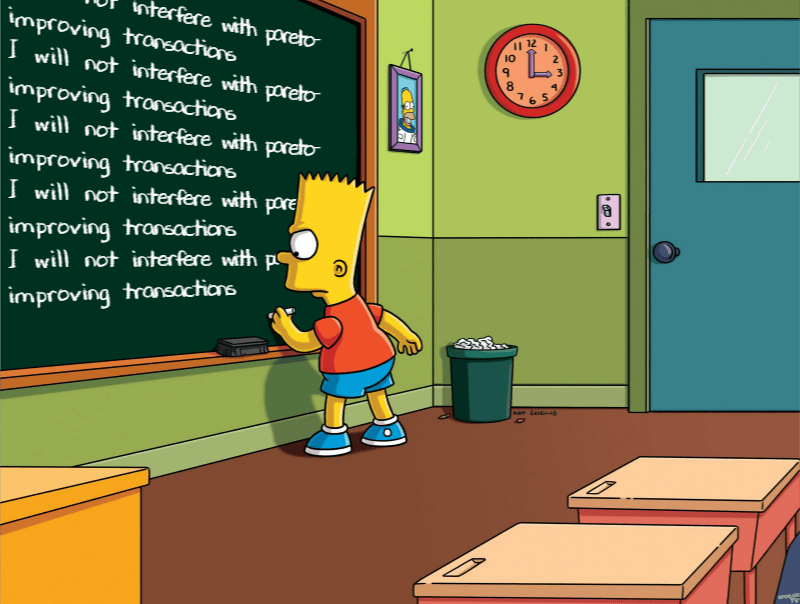
Nonetheless, I think there is no reason that they shouldn’t continue to exist because it seemingly must benefit graduate students who submit papers to them or else they wouldn’t do so. That is to say that graduate conferences are clearly pareto improving, else they would not happen.
These students must benefit from submitting their papers these graduate conferences, or else they would not do so. And there may be a number of reasons for their doing! First, they may think that conventional advice is bad advice. Maybe they have some reason for thinking that graduate conferences are uniquely beneficial in ways that other conferences are not.3 Or, there might be a specific reason for wanting to attend this conference. The only time I ever submitted a paper to a graduate conference was because I was particularly interested in the keynote speaker and the conference was close to home. Or, students might just prefer to pay for a low-stakes place to test out new ideas. I know of at least one graduate student with hefty funding who has seemingly decided to go this route.
Regardless of what their reason is for submitting their paper to graduate conferences, it seems that they benefit from doing so or else they would not do it. And, clearly, students who host conferences also benefit by doing it. Thus, we should feel no shame in our hosting these conferences since we are both made better off by their existing and without this option, both sides would be worse off. It’s a clear pareto-improvement and we should be happy that these conferences exist!
My few conversations with other suggest that this is the greatest benefit that departments get from hosting a conference. ↩︎
You might reply that it is still nice to get feedback on your work from others since it is sometimes difficult to see even the most obvious objections to your view if you don’t talk to anyone about it. But in that case you can talk to graduate students in your own department for the same effect. ↩︎
I’ll be the first to admit that I am skeptical of almost any advice I receive concerning best practices for graduate students. I receive contradictory advice regularly. Maybe these people have no idea what they’re talking about. ↩︎
I began writing this blog post about a year ago but never published it. Luckily, as you will see, there was a great update to the story since I began writing. I am publishing this now to Christen the new blog.
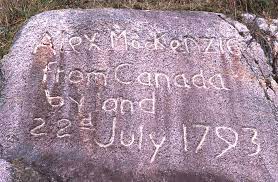
Do you know who the first person to cross North America by land north of Mexico was? It’s Alexander Mackenzie, the one who inscribed his famous “From Canada by Land” into a rock on the Pacific Coast in British Columbia in 1793 (a decade before the American explorers Lewis and Clark would go on their westward expedition if continental bragging rights are something you care about), right? Google the question for yourself and you’ll find very few websites that make such a claim, though. The Canadian Encyclopedia doesn’t make this claim on either their page about Mackenzie or his explorations. Wikipedia won’t say so. Encyclopedia.com doesn’t say as such. Neither does the Ainslie Manson book Alexander MacKenzie: From Canada by Land.
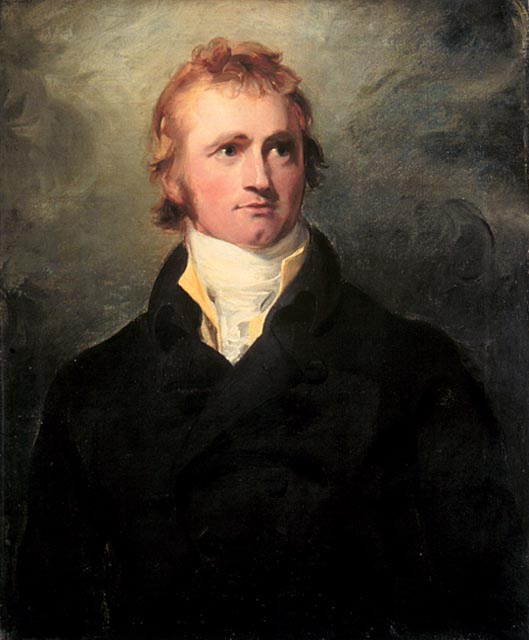
Mackenzie c. 1800
No, these sources will not tell you that Alexander Mackenzie was the first person to cross North America by land north of Mexico. What do they tell us about the intrepid Mackenzie? They tell us that he was the first European to cross North America by land north of Mexico.
Well, that’s much less of an impressive feat if you ask me. Why should we hold him in such high esteem? Are Europeans so great that we should give a damn that one of them was able to mimic the feat of another from who was not so fortunate as to be born in Europe? Why do I know almost nothing of the first person to cross North America by land north of Mexico? Who is this fearless explorer who went where no man has gone before? Google it yourself.
Can you find an answer? Unfortunately, you will not be able to. The reason, I presume, is that Mackenzie was indeed the first person to cross North America by land north of Mexico but to say so is just not done in polite society. But maybe I am wrong.
Perhaps, you think, that there is nothing wrong with what we are being told. After all, isn’t it true that Mackenzie was the first European to cross North America by land north of Mexico? Indeed, it is true. But, I ask you, who is Neil Armstrong? Would you tell me that he was the first American on the moon? Or might you say, as History, Wikipedia, Britannica, and NASA do, that he was the first man on the moon? Obviously, you would say the latter.
But maybe we’re just practicing intellectual humility. We can’t know that Mackenzie was the first person to cross North America by land north of Mexico. After all, didn’t Indigenous people occupy North America for some nineteen thousand years before any Europeans began their colonization of the continent? I agree, we cannot know it to be the case. But if we should practice this sort of intellectual humility and limit our claim by saying only that Mackenzie was the first European to cross north America by land north of Mexico, then I think that we must limit our claim even further in the spirit of intellectual humility. Who is to say that this Mackenzie was the first European to make such a journey? We know very little of the L’Anse aux Meadows, the site of Viking settlement in Newfoundland. Maybe a Viking or two wandered westward and made their way to the Pacific ocean. Or, could there not have been an unrecorded transatlantic crossing which brought forth a brave European who made the land voyage to the Pacific (or even less conceivable but still possible and transpacific voyage which led to a west-to-east land crossing of the continent)? In practicing our intellectual humility, should we not deny Mackenzie his claim to European primacy in crossing North America by land north of Mexico?
We do not take our intellectual humility in this way though. There is no evidence of such a land crossing by a European before Mackenzie. But, as far as I am aware, there is also no evidence of a land crossing by a non-European. If there were, then we would be able to track down the true first land crossing of North America north of Mexico, but no where that I have searched has produced any such result.
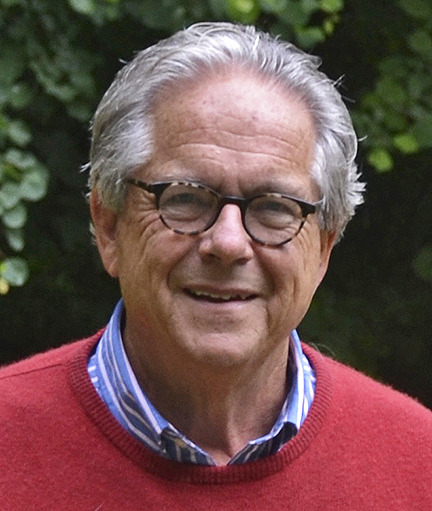
Me Beautiful-Minding Dr. Barry Gough’s email address
I began writing this blog post over a year ago but never found the right time to publish it. But then the most wonderful thing happened. I was reading one of the featured articles in the April-May 2022 edition of Canada’s History Magazine (through a subscription gifted to me by my dear sister), in which we get a detailed account of Mackenzie’s land journey by the historian, Barry Gough. As wonderful as a such a feature was, I found an even more wonderful surprise inside. There on the glossy coated paper were the words, “Make no mistake: Thanks to Indigenous advice, Mackenzie was the first person in recorded history to cross the continent north of Mexico.” I was flabbergasted. This was the first place I had ever seen it in print. I had to get to the bottom of this. Why was the great Barry Gough (who I had only just realized was clearly an undiscovered genius of his time) so sure of this claim. I took a look around the internet to find that Barry Gough was professor emeritus at none other than my Alma Mater, Wilfrid Laurier University. Though his email was not publicly available, I did a little reverse engineering by looking at other faculty names and email addresses. I sent off an email asking why he said person instead of European and prayed for a response.
To my delight, my code-breaking was perfect and Dr. Barry Gough not only received my email but delivered an enthusiastic response:
Dr. Barry Gough
Dear Andrew Thank you for your email, and I appreciate your question, for it is most important.
Some years ago, at a conference on George Vancouver at SFU, I spoke on Mackenzie. It was the essential theme that I developed for First Across the Continent. I have no reason to change my view. However, an Anthropology prof. from SFU told me on that occasion that he had talked with some local First Nations on the matter and was told by them that two Europeans (the prof used the term white men) had come to Pacific tidewater before Mackenzie (by land, I presume). The prof’s name may have been Bill Hober or similar (I am sorry I cannot give you exact information on this.). I was surprised at the remark and dubious about the claim. It is not that I distrust the Indigenous account only that it cannot be verified. Does this help? I hope so.
I was so pleased to be able to keep the Mackenzie odyssey alive in Canadian historical literature. It seems as if the eighteenth century is disappearing quickly in the rearview mirror, especially in academic circles.
What a response! Could a young mind so interested in knowing who was the first person to cross North America by land north of Mexico ask for anything better? The intrigue, the controversy, the follow-up literature! It was all so wonderful. I followed up by responding that I was surprised to hear that the issue was not that Mackenzie was up against some other non-European for the title, but there was a possibility of a different European being the one to have made the first voyage. His second response even more tantalizing:
Thank you, Andrew Remember this is all hearsay, though tantalizingly possible! One reason I doubt it is that Peter Pond never mentioned the prospect, and he was searching for a route to Cook Inlet just before Mackenzie did his voyage to the Arctic. I have written about aspects of this in The Elusive Mr Pond. All good wishes, Barry Gough
What a response again! I even get told what Dr. Gough believes is the primary evidence that his interlocutor was incorrect. It was time for me to take a look into Dr. Gough’s evidence for Mackenzie being the first person to cross North America by land north of Mexico. I ordered a copy of First Across the Continent and I got reading.
The book was great, of the three tellings of the journey I’ve read this was the best (though I’ve not yet read Mackenzie’s own From Montreal). But from the beginning it was not at all clear that the central thesis of the book was that Mackenzie was the first person to travel across North America by land north of Mexico. Instead, the central thesis seemed to be that Mackenzie’s journeys to the Arctic and Pacific oceans were primarily commercial ventures instead of ones driven by a sense of adventure. But nonetheless I pressed on.
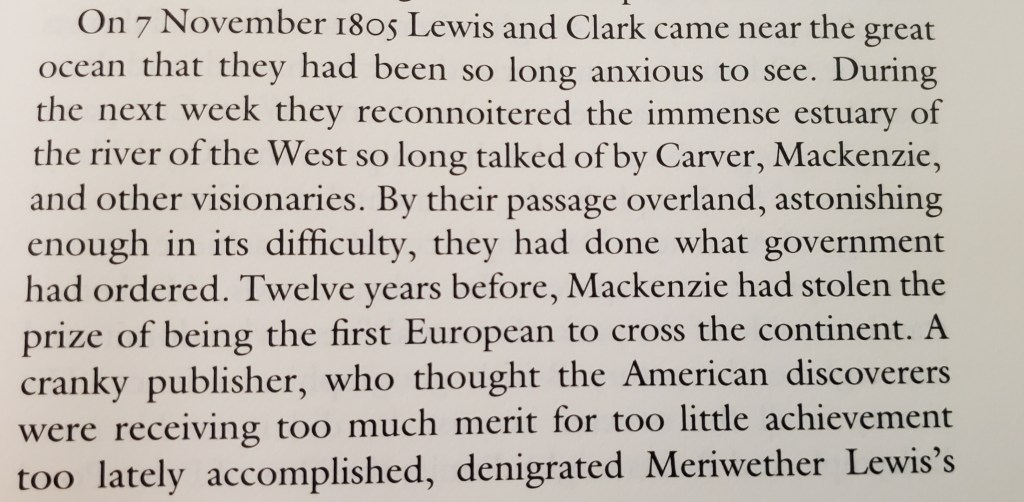
And then it hit me. Right there, dab smack in the middle of page 209 (of 211, mind you). I could not believe my eyes. What was I reading?! Had the great Barry Gough also fallen from grace? For on those pages I read the words, “Twelve years before, Mackenzie had stolen the prize of being the first European to cross the continent.”
The passage that broke my heart
Where had my journey led me? Like Mackenzie making it to the Arctic ocean in 1789 though the journey was great, the destination was a disappointment. Who was the first person to cross North America by land north of Mexico? I might never know. Why did Barry Gough feel so confident in his answer within the pages of Canada’s History magazine as well as in emails to me but not in his book? I wish I knew. None the less, I hope that Mackenzie himself is somewhere looking over me, happy to see that I have a sense of adventure which rivals his own.
This blog post was originally published at The BuffaloFebruary 10th, 2020. The site has since been removed from the web. This was my first op-ed and was praised by an academic I quite like as “one of the most intelligent things to emerge from Laurentian Canada in living memory“. Can you guess who?I would certainly make a few changes if I rewrote this today, (saying “confederacy” instead of “confederation” and describing Red River colonists as “French Catholics” to start) but I’m still very happy with this and I, of course, still stand by the central thesis, so I am reposting it here.
The Alberta independence movement has returned Canada to the nostalgia of our past with western colonies vying for their right to self-determination. Now, instead of the persecution of French Catholics in Manitoba, it is Albertan workers who are bearing the brunt of sweeping federal power. What remedy is given to Albertans? For some who have a vision of a free and unimpeded Alberta the answer, though perhaps radical, is secession.
But, can we justify this secession? Alberta has been a part of our confederacy for over one-hundred years since the province was born out of the Northwest Territories in 1905 along with Saskatchewan. Can the destruction of this one-hundred year union be said to be a just separation? The answer, I posit, is an undoubted and emphatic, yes.
I ask unto Ontarians, by what right do we have to control the fate of our western brothers and sisters in Alberta? By what right should we exercise our vote over two-thousand kilometers away to tell Albertans how they can live their lives? Some answers have been posited; Ontarians are owed Albertan tax dollars in the form of equalization payments and that we must stop Alberta’s environmentally deteriorating practices. Neither, I argue, can justify any impediment to the peaceful secession of Alberta from Canada.
While contentious enough of a claim, let us suppose that Ontarians really are owed equalization payments from Albertans. Is this enough to justify keeping Alberta in the confederacy? Certainly not. Does not Canada send foreign aid all across the world? Canada sends billions to Brazil, China, Italy, Mexico, and other countries across the globe. If Canada is obligated to make payments in foreign aid to these other countries, does it then follow that Canada must come under the legal jurisdiction of these countries? Must we have all of Canada under the democratic control of the Italians simply because we owe them aid? Certainly not! Either the Ontarian must recognize Alberta’s right to make their own foreign aid payments or accept that Canada should be controlled by those whom we make foreign aid payments to.
Of environmental concerns, the opposite argument can be made. If it were true that environmental concerns were enough to deny the right of Albertans to secede, then how can we justify China, who is one of the world’s largest polluters, to be separate from Canada? How can they act as their own sovereign country without Ontarians stepping in and taking control of the entire country? Quickly, one will realize that without exerting federal power, Ontarians can enter into diplomacy with Alberta as a new country just as we do now with China to resolve environmental concerns today.
To Ontarians, I ask that you please consider that our goals for Ontarian-Albertan relations can be resolved without Alberta as part of our union. We need not exert control over a people who not longer want to be a part of our democracy. To Albertans, I ask that you consider your contentedness with a system in which those who live thousands of kilometers away can tell you how to live your life. Ask yourself if you are satisfied with Ontarians, who might never know what it is like to be an Albertan, insisting that you can’t decide for yourself how much money you should be giving them. The time has undoubtedly come for a change. It may be a radical change, but it is a just one. Leave the confederacy.
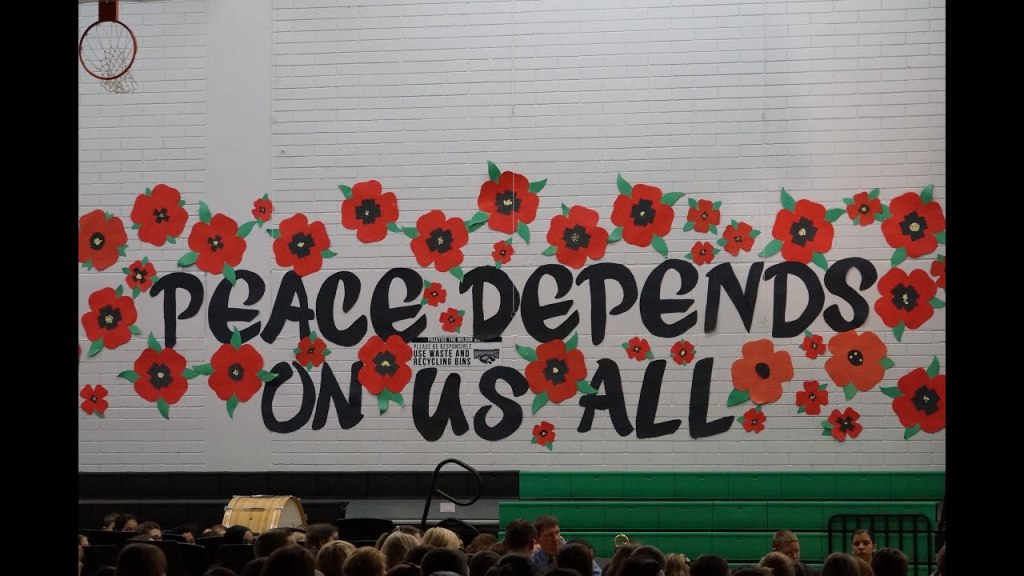
My tenure in elementary school is not so recent and most of my time as a child alludes my memory. But they say that repetition breeds memorization and it is for this reason that some parts of my time at Highland Public School in beautiful Galt, Ontario remain burned into my psyche. One such memory was the Remembrance Day assembly which happened every year on November 11 (or on the Friday prior if the 11th fell on a weekend). Looking back now I see how this was just one of the propagandistic methods used by the State to make sure that my young influenceable mind was ready to warmly embrace Canada’s role in horrific wars.
The assembly had many parts but there were a few that I will never forget. The first is that we could not clap. After any songs or performances it was forbidden. I remember other six-year-olds “shushing” one another who had been so accustomed to clapping after each performance and had forgotten that this assembly was “special” in this way. I also remember that we had to memorize two pieces. The first was the poem “In Flanders Fields”. It’s a lovely poem by the Canadian poet, John McCrae which laments the death of so many young men in the First World War. I have only this year learned that it was a poem that only Canadians knew. I assumed that all students living in what were once allied powers were forced to memorize it like I was but given that it is a Canadian poem, we were perhaps most happy to embrace it as a cultural staple.
The other piece that we were to memorize was the folk song, “Where Have All the Flowers Gone?”. It was written by Pete Seeger in 1955 but the the popular version by the Kingston Trio from 1961 was the one that I remember being played for us. Where have the flowers gone? Well they’ve been picked by young women who take them to the graves of their husbands who had died in war. At the end of each verse we are asked, “When will they ever learn? When will they ever learn?”. A lovely song, no doubt.
I was a young man of four years when I began attending Highland Public. I was in Junior Kindergarten in Ms. Cipolla’s class. That was in 2001. The Remembrance Day assembly took place, as always, in November of that year, after I had been attending classes for only two months. It was likely then that I heard the song for the first time. Though I didn’t think too much about it, the message of the song was clear for the seven years that I attended that school: Those bastard Germans need to learn their lesson and stop doing this war business. It’s a damn fine thing that we fought them all those years ago but it’s a shame that we lost so many Canadians in the process. “When will they ever learn?” I thought, “When will they ever learn?” Germany was the only ‘bad guy’ I knew about at the time and they were certainly guilty of war-making at least once.
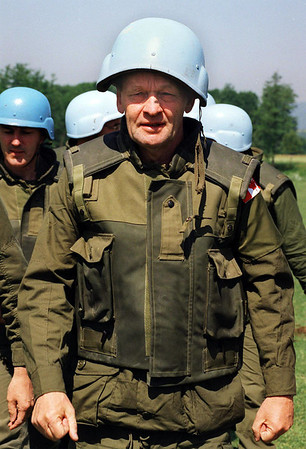
The Right Honourable Jean Chrétien ready for battle
It is only now that I should look back upon this ritual with such disgust. This first time that I was in that assembly was only one month before Canada’s Joint Task Force 2 would land in Afghanistan. Our Prime Minister Jean Chrétien (pictured) was just beginning to lead a war which would last over a decade halfway across the world. And during that decade or so of war, I sat in assemblies at Highland Public School and eventually St. Andrew’s Public School and then Galt Collegiate Institute singing that same song asking, “When will they ever learn? When will they ever learn?”
But who were we asking? Who was the they that was to learn? Each year they would ring from the stage the number of Canadians who had fallen in Afghanistan. Did we not ask that we might learn? That we might learn that these deaths are needless? That we might learn that the horrors of war are perhaps to much to bear and that we ought not bear them when we can avoid it? It was Canada that needed to learn. But every year we would hang our heads and mourn the deaths of these young men and women who passed. All for a great cause, no doubt. That could never be questioned. “When will they ever learn?” couldn’t mean us. It couldn’t mean that we were needlessly sending men and women to die. No, no. It was someone else. Not the Germans this time, but someone else needed to learn.
Here in 2021 it is only so obvious that we did not learn. That those men and women did not need to die and that our precious scarce resources did not need to be wasted on a war which did nothing. Which war will be next? Which hopeless, needless, and seemingly endless war will we next plunge ourselves into? And to whom will the four-year-olds ask “When will they ever learn? When will they ever learn?”
It was, of course, totally justified and absolutely necessary that the Northern U.S. states invaded the Southern U.S. states in 1861 in what is properly called the “U.S. Civil War”. To think otherwise makes one a barbarian, a brute, or a neanderthal. Since I am none of those things, I accept whole heartedly the contention that the Union was completely justified in its bloody pursuit to bring the seceding U.S. states under their control. It is for this reason that I must point out the glaringly obvious historical miscarriage of justice which arose in 1833. Having just passed the Slavery Abolition Act, the United Kingdom should have gone forthwith and declared war on the United States. After all, it would not be another thirty-two years until the the united states would pass the thirteenth amendment abolishing slavery. How could this injustice stand? Just as it was pertinent that the North invade the South in order to abolish slavery, it is was also pertinent that the UK invade the U.S.
“But things are quite different,” you say. “The seceding southern states were once a part of the United States. They even destroyed federal property in their attack on Fort Sumter in the seceding state of South Carolina.” But, I tell you, it is just the same. For did not Americans attack the powder stores of the British in the opening battles of the Revolutionary War[1]? Just the same, the British had every right to invade the U.S. Their land was once British and their own federal property was attacked by those Americans. It really is no different at all! Where was the war-making in the name of justice and progress from the UK? It is but a sad historical shame that it never happened.
“But,” you say, “in 1833 the British still practiced slavery in parts of their empire such as in their holdings with the East India Company, in Sri Lanka, and in Saint Helena. How could the British, who clearly did not oppose slavery in principle, be trusted to invade the U.S.? This could not be a case of benevolent imperialism.” While you may think you have found a distinction between the British and the North, I am sorry to say that rather than a distinction, you have found only another parallel! At the beginning of the Civil War, four Northern states, Delaware, Maryland, Kentucky, and Missouri, known as the border states, still practiced slavery. Surely there is no need to wait for the righteous side to totally practice what they preach in order to rectify an injustice in the seceded state. War must happen now! If you disagree with this view, you will have to tell it to Mr. Abraham Lincoln himself. He thought that it was so important that he not delay his war that when he issued the Emancipation Proclamation in 1863, he excluded the border states and the half-million slaves within them. No need to upset those non-seceding states, even if they did practice slavery. Due haste, I say! Due haste in war-making! Bring the British Navy across the Atlantic crush those slavers in the U.S. Just as the border states still practicing slavery did not make Lincoln’s war unjust, neither would the UK’s practice of slavery in their colonies make an 1833 invasion of the U.S. unjust.
It’s high time that American historians, politicians, and high school teachers begin pointing to this gross miscarriage of justice in 1833. The UK had an obligation to invade the U.S. and their shirked their responsibility. As a civilized person of the twenty-first century, it is all too easy to see the obvious truth that the North (the winning side who now rightfully controls federal education policy) was absolutely justified in its invasion of the South. As such, I cannot help but bring to the attention of my readers the great injustice of 1833. There was no invasion, and thus, no justice. Let us look upon this dark history of non-aggression by the UK with as much distain and disgust as we would if the North had not invaded the South.
[1] I should quickly pause to point out that this was a revolutionary war or a war of independence, unlike the Civil War. The U.S., of course, did not seek to control all of England, they merely hoped to gain independence. This is totally unlike the South who… well they lost, so no matter
Two weekends ago I went to the Students for Liberty Top Leadership Retreat in Twin Lake Michigan, just outside of Grand Rapids. It was a great trip and I was happy to connect in person with people whom I had spent a long time only knowing online. There were also great talks including a surprise visit from Justin Amash! All great fun, really. What I want to talk about here is some of what struck me as oddities from the young American libertarians whom I had the pleasure of speaking with that weekend.
The Constitution
Those Americans love that damn constitution of theirs. Many talks which would decry this or that government policy or legislation would often end with the exclamation, “and, it’s unconstitutional, you know.” Being but a mere Canadian, perhaps I cannot properly appreciate the importance of this insight, but this didn’t mean all too much to me. My constitution did not have anything to say on civil asset forfeiture, the war on drugs, or gun bans. Perhaps I was therefore incorrect in judging these things to be unjust, immoral, criminal, or inefficient since my constitution did not forbid them. The truth, of course, as even these Americans I’m sure would admit, is that whether or not something is constitutionally enshrined or not is no indicator of its justice. Civil asset forfeiture is wrong regardless of whether or not there are constitutional grounds for it. Under my constitution or theirs, it is wrong. I am reminded of the words of Murray Rothbard speaking at the Libertarian International World Libertarian Convention in 1982 in Zurich, Switzerland:
Libertarianism itself, of course, is international, it’s transnational, it’s cosmopolite. The glorious idea of liberty, of a free market, and a free society is universal. It is not dependent on culture or time or place. For that ideal is based on the nature and on the rights of man, of human beings, wherever they exist.
While the constitution might be convincing to others in trying to persuade them of the justice of our side, I don’t know that such appeals are necessary to people who are already libertarians. Would we not feel the exact same way about some policy if it was indeed constitutional? And doesn’t the constitution have explicitly anti-libertarian clauses as well? What of the infamous Commerce Clause? “[The Congress shall have Power] To regulate Commerce with foreign Nations, and among the several States, and with the Indian Tribes”. Even without debate regarding interpretation, it is clear that this violates some libertarian principles of free trade. What do we say in this case? Imagine a protectionist approaches us and says, “You know, it’s in the constitution that congress has the power to regulate international trade.” What is the proper response? For me, “Who cares?” For libertarians concerned with the constitutionality of some policy, I’m not sure.
I also found it puzzling that it would be decried that the constitution forbids some government policy which has been practiced for years. Does it then? It would seem that the Supreme Court does not think so. And it would seem that that oh-so-loved document has not done the glorious work that we praise it of doing. Let us not forget of the words of the great Lysander Spooner (a figure highly praised by SFL!), “Whether the Constitution really be one thing, or another, this much is certain – that it has either authorized such a government as we have had, or has been powerless to prevent it. In either case, it is unfit to exist.”
The Union
I was also incredibly surprised by the view of many Americans of the American Union. “I like our union,” I heard. “I think it should continue to exist,” they would tell me. Forever!? This is the question I must ask of them! Would it be such a horror if Hawaii were to try and make it on their own? It is surprising to hear on one hand that some of these students say they are “sympathetic to anarchism” but then turn around and suggest that one of the largest and most destructive states on the planet ought to continue to exist in perpetuity! My uneducated guess is that a bad experience in the 1860s has had cultural reverb leading even my radical friends to fear a repeat.
The implication of their view is one that I do not think they take seriously enough. As the good libertarians that they are, they are war doves. But suppose that Californians had had enough and tomorrow voted in a referendum to secede from the U.S. with 99% voting yes. The California legislature creates a new constitution and builds the proper institutions to implement it and says “sayonara” to the U.S. Then what? Would these pro-union libertarians call upon those ever-impatient war hawks in D.C. to go forthwith and declare war on the Independent State of California? I’m not sure.
Terry Fox
They don’t know who Terry Fox is! Wild! He was voted the second greatest Canadian and they’ve never even heard of him. They couldn’t really even grasp what he had done when we explained it to them. Unfortunately, there’s no American Terry Fox equivalent for me to quip that “we Canadians know about him!” but I feel that if there was one, I would know about him and I would complain.
Through a busy seven days of writing term papers, grading undergraduate work, and writing blog posts, I had the fortune of attending the #NoMoreLockdowns protest at Confederation Square in Peterborough where I’m currently living (for at least the next four months). The protest began at noon on Saturday. It was only about 11:40 when my girlfriend asked me if I knew that Maxime Bernier was attending a protest in Peterborough that day. I did not! But I jumped at the chance to go and got there less than twenty-five minutes later.
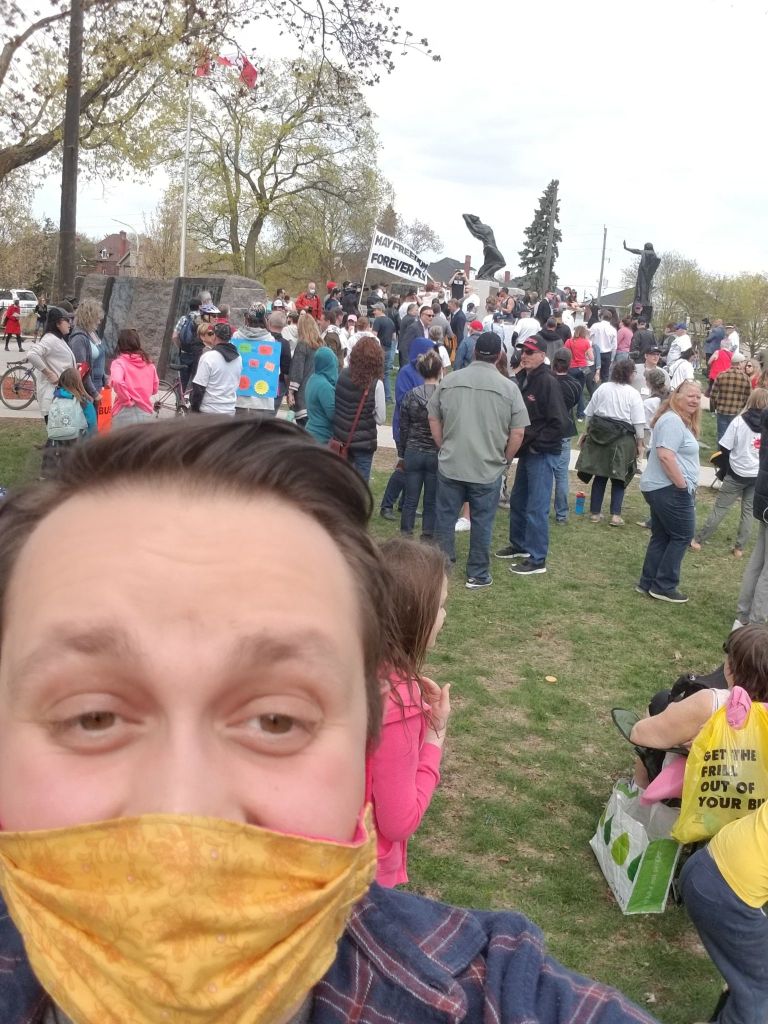
The Atmosphere It was great to be back out with people around me in a setting other than a grocery store. I spotted more than one Gadsden flag, a F🍁ck Trudeau flag, and a beautiful (I believe) handmade flag which read “May Freedom Forever Fly” (pictured). There were a few people handing out “literature” about the dangers of vaccines and masks. I decided it was best for my own health that I not read any. In terms of masks, there were very few people wearing them. There were a few camera crews who were wearing them, some counter-protestors (just a couple of angry old folks) who wore them, and all of the cops wore them. Of anti-lockdowners, I think I only spotted about three others of the twelve-hundred protestors wearing one. I personally sported a lovely fabric mask with a yellow floral pattern (pictured along with my clearly deteriorating hairline). I know we were outside, but it was a large group and it can’t hurt you to wear a mask (despite what Jeffrey Tucker might tell you) so I wore one to the dismayed reactions of others.
Me, my mask, and my hairline
The Speeches: Good and Bad
The first speech of the day came from a woman who appeared to be the primary organizer of the event. Her view was that people who opposed the lockdowns were the ones truly following the science since the media was silencing doctors and other experts who spoke up against the lockdowns and mask mandates. I’m sure there has been a great deal of censorship of experts with dissenting opinions. But why are those the right experts to trust? How do we decide which experts are good experts and which ones are bad? Does being censored by media make you more likely to be correct? I’m not sure I have the medical acumen to distinguish between correct and incorrect scientists myself, so I’ll heed some precautionary advice when it’s of little cost to myself. The problem that I think this sort of talk about the “true” science causes is for anti-lockdowners to get bogged down in discussing sciences which none of us are all-too-familiar. The truth of it is that it doesn’t matter what the science says. There are other reasons to oppose lockdowns such as political objections to the clear expansion of government power, moral objections to the coercive restrictions on use of property, and economic objections to the obstructions that lockdowns create for production. I do not need to be an expert in epidemiology to ask, “Shouldn’t I be free to invite whomever I please onto my property?”
The next speech was from a Christian gentleman who began by asking us what the greatest expression of love is. If you didn’t know, Jesus’ answer was “Greater love has no man than this, that a man lay down his life for his friends.” The gentleman said that he was not at this protest for himself as he was largely unaffected by the lockdowns. But it was for others; others who had had their businesses closed, who had lost their jobs, who could not see family when they needed to, that he attended the protest. He risked tickets, arrest, and humiliation from others for the sake of his friends. So well said! I also fall into a similar category. My life has not been too shaken by lockdowns. I am still paid handsomely by the provincial government, I was able to move to Calgary and then to Peterborough while remaining at student at the University of Waterloo, and I now get to attend conferences and reading groups virtually which would have otherwise been prohibitively expensive for me. I think this way of thinking might be useful for some pro-lockdown people I know who have called for more and more restrictions while their income has been virtually unhindered by lockdowns: Not everyone is affected by these lockdowns the way you are. Just because you can “suck it up” and avoid a haircut for a few months, you may want to remember that others are now without job and without hope because of these lockdowns.
A blurry Maxime Bernier
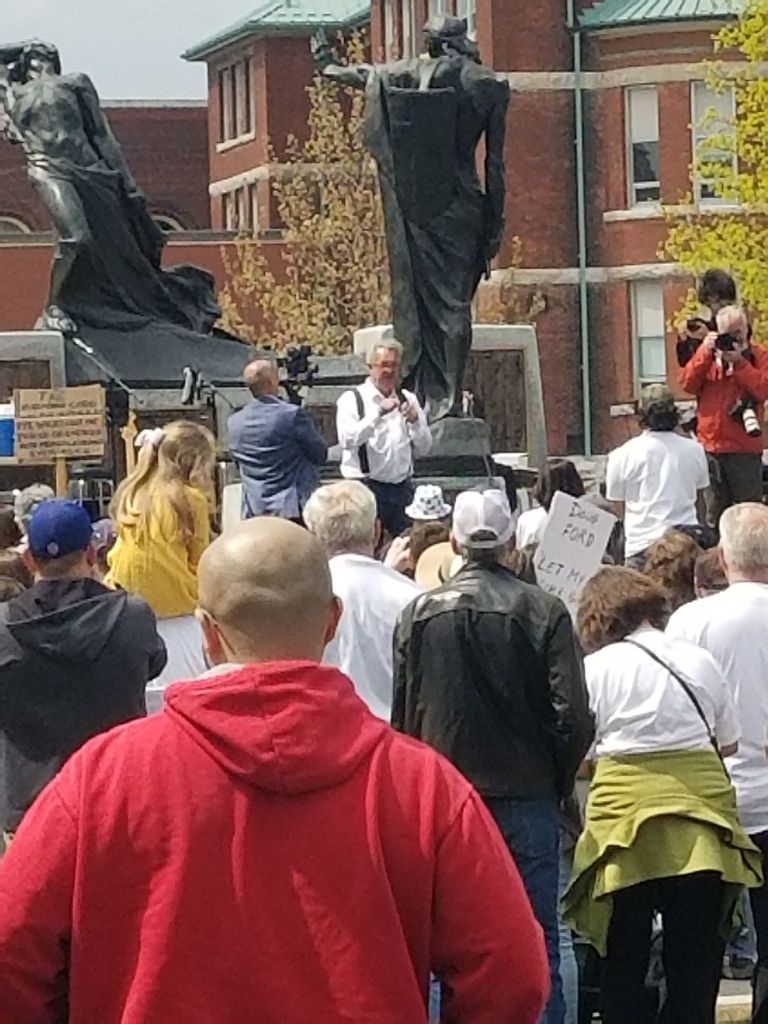
The third speech of the day was by far the most anticipated. Mr. Maxime Bernier (blurrily pictured) – who I happily voted for in the 2019 federal election – gave an excellent speech full of great “rights talk”. What was Bernier worried about? Our freedom is under attack. And surely it is! How free is someone if they cannot see their own mother for Mother’s day without fear of being arrested and ticketed? He went on to say that “every business is essential”. Again, wonderful. If you are the owner of a business or one of its employees, that income is likely damn essential for you. Bernier made clear that there were genuine medical concerns that we faced and that we ought to protect the vulnerable. Of course! As I have tried to emphasize. There is no need to be a COVID-denier to oppose lockdowns. Saying that, he interjected, “But, we need to reopen our economy”. Right again! Aren’t these restrictive lockdown a massive burden on productive actions? I would like to produce such and such good in such and such way, but I cannot because I fear being arrested. Or, I hope to exchange this good for some other good which I get greater satisfaction from, but I cannot because Ford will arrest the seller for selling it to me (while I thought that rugs and laptops might be essential during lockdowns, the Ford administration apparently disagrees to the great distress of my girlfriend and I who have needed both in the last two weeks). Finally, Bernier ends with a call to avoid a “show me your papers” society. On all fronts, great. We want freedom, the ability to work, a productive economy, and to stop government overreach. We do not need some heterodox “true” science to tell us that.
The next “speech” (if you can call it that) was a slam poem whose exact details escape me but had the repeated line of “we are the grass in the cracks of mankind”. I am not much of a poetry buff but I couldn’t quite make out what that meant.
The next speech was from a veteran who brought up other veterans and told us that “this is what they fought for”. If there are veterans who support lockdowns is that what they were fighting for? Not sure I need vets on my side to tell me that I’m correct, but I’ll take the encouragement.
Then, we had a speech from a gentleman who was trying to tell me what my constitutional rights were but wasn’t so sure himself. He mentioned the seven “Fundamental Freedoms” which our Charter of Rights and Freedoms guarantees us. He asked if we could name them. I couldn’t, could you? (answer here). He then went on to let us know that the notwithstanding clause meant that there were some instances where governments could legally infringe upon those freedoms. Was the COVID-19 pandemic such an instance? He wasn’t really sure. But he didn’t want it to be. Great. I’m glad I got a real legal expert’s analysis on that. He went on to say that we, the anti-lockdowners, were the “true majority”. My response? Who cares!? First of all, the claim is empirically dubious. Second, would it make a difference if we weren’t? Suppose that he’s right and that 60% of Canadians oppose lockdowns. Now, suppose that by some piece of government propaganda, 20% “defect” to the pro-lockdown side. Does our position cease to be correct? Are we now bumbling idiots who have no sense of right and wrong, and should really be on the side of the pro-lockdowners? Of course not! Who cares whether or not we are in the majority, we are in the right!
An even blurrier Randy Hillier
Finally, we had the speech of Randy Hillier (also blurrily pictured). Hillier had two great points. The first was that he didn’t want to live in a police state. Well fair enough! What else do you call a place where police are legally allowed to pull you over and ask you where you’re going with no other evidence that you’ve broken the law except that you’re going somewhere? He also mentioned that the Peterborough Police tried to give him a ticket before the event. Imagine having broken no law but getting a ticket because the police anticipate that you will break the law. The second was that there is a clear division between the government bureaucrats and the “productive” class of people who pay taxes (truly Calhounian). It is easy for those bureaucrats to tell the productive folks (off of whom they live parasitically) that they need to give up their income while you sit comfortably, working from home, making your full salary. Another great speech.
Peterborough Police: Friend or Foe?
Finally, I want to turn to the question of how the protest viewed the Peterborough police. When the veteran came up to speak, he asked us to thank the Peterborough police. Thus far, no one was given a ticket and just a week earlier they had agreed not to follow Ford’s orders to randomly stop people to ask where they were going. Fair enough, all things considered, the Peterborough police could be much worse.
But things changed quite quickly once Hillier stepped up. First, he immediately denounced them and said that they were there to “intimidate us”. They seemed pretty friendly to me. They just stood there and waved hello to passers by. But people who had previously applauded the Peterborough police were now booing them.
Bernier getting a ticket while Hillier shouts in the back
The real trouble came when Bernier tried to leave the stage and he was approached by a police officer who wrote him a ticket (pictured). People surrounded the cop and when he moved away after giving Bernier his ticket, people followed. It was at this point that I spotted my chance to go talk to Bernier. Everyone was following the cop, not Bernier. So I ran in the opposite direction and grabbed his arm and he grabbed mine back (butterflies I tell you, I was like those women at a Beatles concert) and I said, “Thank you Mr. Bernier, I love what you’re doing”. He gave me a head nod and what I think was a “oui”. The man had to leave before things got ugly, he didn’t have time to talk to the one weird kid in a mask! Fair enough Mr. Bernier, I still love (most of) what you’re doing!
While just one minute ago Hillier was yelling “Shame! Shame! Shame!” over the microphone, it was at this point that he said to the crowd, “We’re not here to be violent” and urged people to leave the cop alone. Well done Hillier, I don’t know that I would have had the collectedness to have done the same. After that, I left. I didn’t want to be part of a mass exodus in case police officers decided that then would be their time to give out tickets to everyone.
Takeaways
This was fun and a great event. It can be lonely thinking that there is no one around you who thinks similarly about lockdowns. It is also unfortunate that there is so much likely false medical and scientific information being spread around at these protests. There is no need to deny that COVID is real or even deny that lockdowns might mitigate the spread of COVID in order to oppose lockdowns. While I recognize that a speed limit on the 401 of five kilometers-per-hour would likely reduce highway traffic deaths, I don’t think that we ought to reduce the speed limit. I accept, like almost everyone does, that there will be some increased number of deaths in exchange for other things we value such as getting to work, seeing family, and getting to your place of worship. I dream that history will see the anti-lockdowners as sort of anti-authoritarian protestors (although given what we’re taught about the October Crisis, I’m not so hopeful). But if the message is mixed in with anti-science rhetoric, I don’t know that history will look on these protestors as such. More than anything, I hope that lockdowns will end and I pray that events like these do something to further that cause. While things are getting worse and feeling hopeless, an event like this has given me hope.
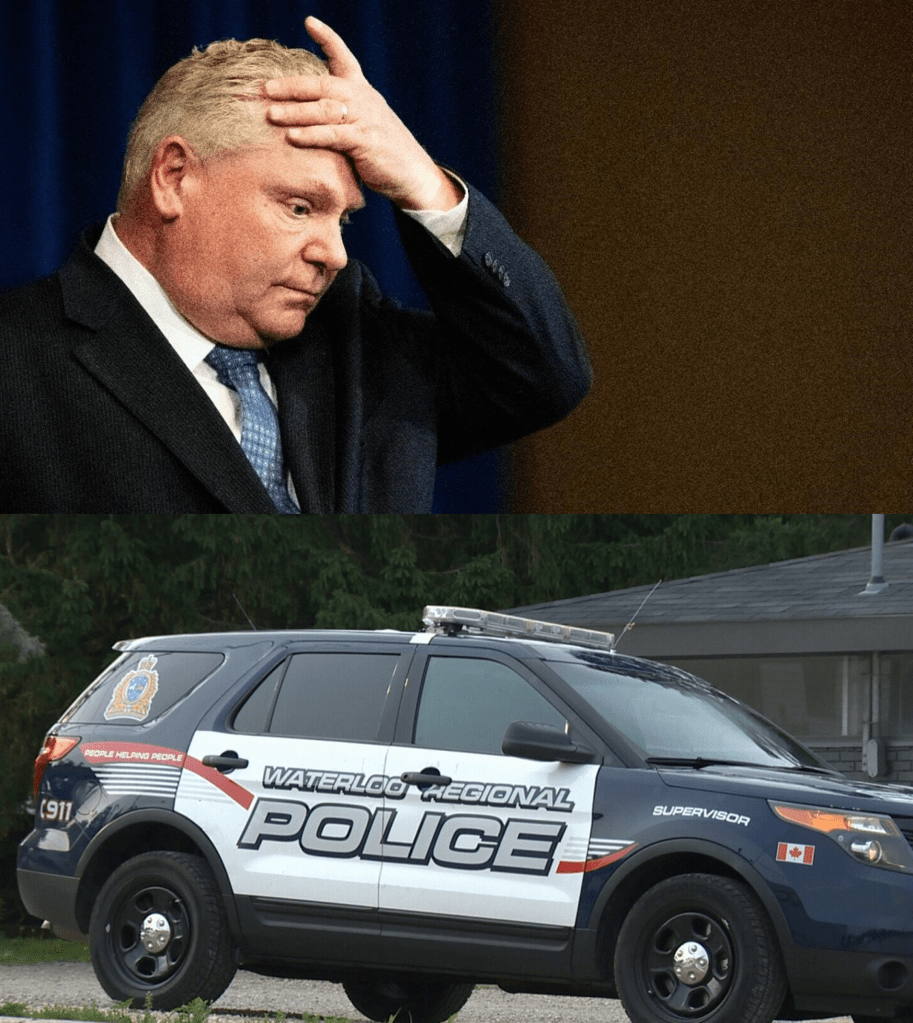
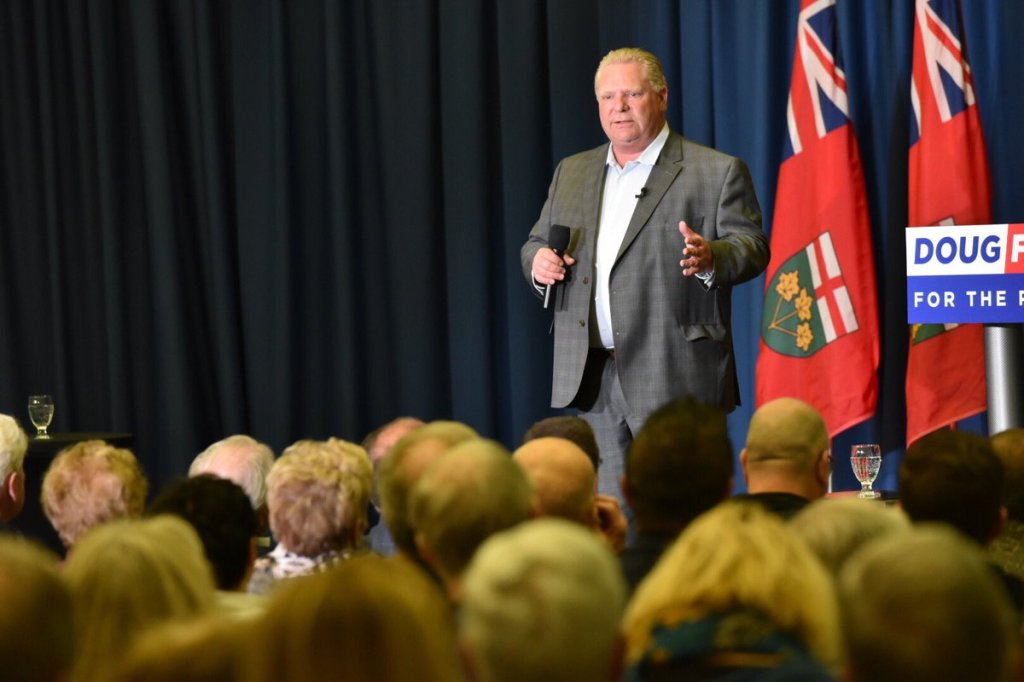
A great and wonderful thing is happening here in Ontario! Doug Ford and his “conservative” party have implemented (by his own admission) “the strictest measures in all of North America” in order to combat the spread of COVID-19. That’s not the good news, of course. It is the public reaction to these lockdowns that is so wonderful. They are finally being met with some popular resistance! There are calls for Ford to resign and Ontarians ran to Niagara Falls sending SOS signals to our southern neighbors. Even the pro-lockdown left-liberals have come out against Ford’s new restrictions. Of course, their opposition arises because Ford hasn’t “followed the science”; they have not stopped to ask if forcing 14 million people to stay in their homes except for government-approved activities might be morally objectionable, but it’s a welcome change in tune nonetheless.
But there is something even more wonderful and heartwarming happening. Not only have we finally seen popular resistance from both sides of the political aisle (of course “respectable” conservatives have never opposed the lockdowns lest they be kicked out of their party. We can only turn to the Ontario Libertarian Party and the People’s Party of Canada to find vocal opposition over the last year) but we have seen what is truly a remarkable turn of events from regional and municipal police forces. All over Ontario; in Hamilton, Waterloo, Peterborough, Sudbury, London, and other municipalities and regions, local police forces have publicly declared that they will not enforce Ford’s tyrannical lockdown measures with random vehicle stops; a “temporary” increase in police power which the Ford government announced on Friday.
What an unexpected but welcome response. What a great future we might see if local police forces started deciding which provincial legislation to enforce (and an even better future if they did the same with federal legislation)! Imagine if those centers of Canadian power in Toronto and Ottawa were to lose the violent enforcement arm of their organizations i.e. the cops. No longer could bureaucrats in Queen’s Park tell autoworkers in Windsor, some 350km away, miners in Sudbury, some 400km away, or paper manufacturers in Thunder Bay some 1,400km away, how much cannabis they can have, how much they can rent housing for, or where they can buy their milk with the mere stroke of a pen. Instead, they must hope that the local police forces there will decide to enforce their edicts. If this were to be the new norm, there may be greater importance placed on local government. Now, those council members which make up various local police boards might do much more than decide which areas to patrol for parking violations but would have a real say in which provincial legislation was enforced in their area. What an incredible shift towards decentralization this would be!
Not only would this plunge a knife into the side of centralized government in Ontario, but it might actually help us get through this pandemic. Last November I had the pleasure of hearing Katherine DeLand speak at the University of Waterloo, “Research Talks: Curing the COVID-19 pandemic”. Deland was part of the World Health Organization’s Ebola response. In her talk, she made clear the importance of local solutions to problems surrounding the Ebola outbreak. Different areas had different needs depending on a number of factors including the resources available to them and their culture. Suffice it to say, this was not exactly the talk I had expected to receive from a member of the WHO.
The always brilliant Hans-Hermann Hoppe echoed this sentiment in his excellent interview with Thomas Jacob saying,
[I]f the course of current events has demonstrated anything, it is not how necessary or efficient central authorities and decisions are, but conversely how critically important decentralized decisions and decision-makers are.
The danger emanating from an epidemic is never the same everywhere, for everyone, at the same time. The situation in France is different than that in Germany or Congo, and conditions in China are not the same as in Japan. And within diverse countries, the threat level differs from region to region, from one city to another, between urban and rural areas, depending on the demographic and cultural composition of the population. Moreover, there is a whole range of greatly differing assessments and proposals concerning what and what not to do in the face of this threat level, all put forward by equally “certified scientific experts.” Therefore, any centralized, nationwide (in extreme cases, worldwide) measure to avert danger – a “one-size-fits-all” model – must from the outset seem absurd and inappropriate.
But we need not only reject national and global solutions to the pandemic, we must go further. If it really is the case that local solutions are preferable to centralized (i.e. provincial or federal) ones, then why stop at municipalities? Don’t particular burrows, districts, and neighborhoods have distinct needs which vary from others? What about individual city blocks? Or individual households? Might we even go so far as to suggest that decision-making should be left to each individual who has his own needs, resources, plans, and projects to consider?
We’re not there yet, but an Ontario where the provincial government cannot count on local authorities to enforce its legislation is a start. The decisions from these police departments rings out in hopefulness for a better, decentralized future.
Two days ago the Ford government issued a stay-at-home order following a declaration of the second state of emergency since the beginning of the COVID-19 pandemic. After some had claimed that there was “confusion” surrounding the new orders the Ford administration offered this FAQ.
The FAQ attempts to define some of the confusing language within the stay-at-home order by… not defining anything. What is an “essential item”? They answer,
The Government of Ontario cannot determine what is essential for every person in this province, each with their own unique circumstances and regional considerations. Legally defining what is essential risks cutting people off from goods that may legitimately be necessary for their health, well-being and safety.
What is an essential trip? Their answer offers similar laser precision in their legal definition:
The Government of Ontario cannot determine what is essential for every person in this province, each with their own unique circumstances and regional considerations. That said, we have provided broad categories that people should consider before leaving their home: food, health-care services, including medication, exercise or work, where someone’s job cannot be done at home.
While these definitions explicitly refuse to offer a definition, Ford, pompously and arrogantly, decries in an interview, “Folks, there is no confusion here, it’s very simple: Stay home. Stay home. That’s it. If you’re questioning, should I go out? you’ve got your answer: Stay home.” Of course, people might question whether or not they should leave for something which is “legitimately necessary for their health” in order to not harm others but Ford could not possibly imagine such a sacrifice.
Asking for real definitions of what is and is not permitted is completely reasonable. As Solicitor General Sylvia Jones explains, “If people are found not complying with these orders, they will be subject to fines and prosecution. Penalties may include up to a year in jail”! Ontarians might like to know whether what they are doing could land them in jail for a year!
In his 1964 book, The Morality of Law, Lon L. Fuller offers eight principles which make up the “inner morality of law”. Fuller claims that if one fails to abide by these eight principles when lawmaking, they will fail to produce law at all. One of the ways someone can fail to make a law is a “failure to make laws understandable”. Fuller writes that “The desideratum of clarity represents one of the most essential ingredients of legality.” Fuller tells a parable of King Rex who writes a law code which was “truly a masterpiece of obscurity. Legal experts who studied it declared that there was not a single sentence in it that could be understood either by an ordinary citizen or by a trained lawyer.” Rex’s subjects asked the following question: “How can anybody follow a rule that nobody can understand?”
This is precisely the question that Ontarians should be asking about the stay-at-home order. We face up to a year in jail for breaking a law which we cannot understand! And this is not by mere accident. The Ford government is explicit in their unwillingness to define the very acts which they call illegal. But the threat of violence is nonetheless present! ‘Follow these rules or we will haul you off to jail’ they tell us! But how can we follow this law? We do not understand it.
Thus as Fuller points out, this is not law at all but failure to produce law and the unclear stay-at-home order does not give us law, but gives us lawlessness!
Murray Rothbard’s disruptive paper, “Toward a Reconstruction of Utility and Welfare Economics” has given Rothbardians a foundation for welfare economics which relies on demonstrated preferences. What are demonstrated preferences? As Rothbard explains;
The concept of demonstrated preference is simply this: that actual choice reveals, or demonstrates, a man’s preferences; that is, that his preferences are deducible from what he has chosen in action. Thus, if a man chooses to spend an hour at a concert rather than a movie, we deduce that the former was preferred, or ranked higher on his value scale. Similarly, if a man spends five dollars on a shirt we deduce that he preferred purchasing the shirt to any other uses he could have found for the money.
This gives us an important insight about the nature of exchange. Namely, that if two people participate in voluntary exchange, both will receive that which they prefer in the exchange. If Jones trades $10 to Smith for a radio, Jones demonstrates that he prefers the radio to the $10 and Smith demonstrates that he prefers the $10 to the radio.
But does it mean that both parties benefit from voluntary exchange? There is a subtle but important distinction between the assertion that both parties benefit from their exchange, and that both parties gain that which they prefer. What does it mean to be benefitted by something? As Daniel Hausman and Michael McPherson point out in their book Economic Analysis, Moral Philosophy, and Public Policy (p. 119), what constitutes well-being is not intuitively clear; opinions are widely differentiated. As they explain, some believe that well-being is a matter of relationship with God. Others such as Bentham or Mill believe that well-being is a mental state which they refer to as pleasure and happiness respectively. Others still, such as Nietzsche, reject the mental-state view and believed that great achievements were the mark of well-being. Thus, it is not intuitively clear that getting one’s preferences is equivalent to being benefitted.
But Rothbard clarifies what he means about benefit and well-being. He takes the subjective mental-states view of well-being. That is, that what makes someone better off is subjective to the individual who is making choices. But Rothbard does not immediately equate getting one’s preferences with being benefitted. Instead, he takes the following approach when analyzing voluntary exchange:
Let us now consider exchanges on the free market. Such an exchange is voluntarily undertaken by both parties. Therefore, the very fact that an exchange takes place demonstrates that both parties benefit (or more strictly, expect to benefit) from the exchange. The fact that both parties chose the exchange demonstrates that they both benefit.
This distinction is an important one. According to this analysis, the preferences that people demonstrate are not preferences for that which will benefit them, but for that which they expect to benefit them. This distinction has certainly retained its place within Rothbardian welfare economics. See, for example, Hans-Hermann Hoppe’s essay, “Austrian Rationalism in the Age of the Decline of Positivism” in which he explains that “every voluntary exchange starting from this basis must also be regarded as a Pareto optimal change because it can only take place if both parties expect to benefit from it.”
This has some interesting implications for the way we describe people’s choices. It seems that while we recognize that people expect to benefit from their choices ex-ante, it is only ex-post that we can determine whether or not they do, in fact, benefit. Certainly it is possible that Jones may buy $10,000 of lumber to construct a house which he expects to sell for $20,000 only to find out, once the house is built, that he can only receive a price of $8,000.
This is not a problem for Rothbard’s view of well-being. As Ohad Osterreicher writes in defense of Rothbard, “as economists, we cannot infer anything about ex-post utility from demonstrated preference. This knowledge is barred to us.” He continues with the contention that, “the unhampered market is the best institution for mitigating errors and thus maximizing ex-post utility.”
But the way in which we ordinarily speak about well-being tends to include ex-post benefits. Consider the following example from Hausman’s book chapter, “Mindless or Mindful Economics: A Methodological Evaluation”, of “a healthy and nonsuicidal American tourist named Ellen [who] steps in front of a rapidly moving London taxi”. (If you don’t know, the English never learned that you’re supposed to drive on the right side of the road). Hausman argues that Ellen can be benefitted by coercive action against her: “Suppose that when Ellen sets out to cross the street a helpful bystander grabs her and pulls her back. After the initial shock of having been grabbed by a stranger, Ellen is grateful. But she was nevertheless coerced.”
In this example, Rothbard’s ex-ante account of demonstrated preferences is still completely valid. When Ellen stepped out onto the street she expected to benefit. She thought that she would move towards her end of crossing the street. But it seems that this account of welfare would still lack important features about what we mean when we ordinarily speak about well-being. In this case, Ellen wanted to not be hit by the taxi, but nonetheless the preference she demonstrated was to do that which would lead to her demise. While, ex-ante, we could say that she expected to benefit, it would seem clear that she would not benefit from this action, ex-post.
But demonstrated preference still has great merit! One reason that economists may want to rely on demonstrated preferences and ex-ante expectations of well-being is an epistemological one. Economists cannot know whether or not someone will benefit ex-post from any given choice. Consider the example Ellen once again from the perspective of the bystander. Prior to Ellen crossing the street, he does not know that Ellen is nonsuicidal. Ellen may have wished to kill herself and any continuation of her life would make her worse-off. In this case, by saving Ellen, the bystander has actually harmed her both ex-ante and ex-post. (For argument’s sake we will ignore the well-being of the taxi driver).
This is also true for economists. One’s choices are still indicators of one’s preferences which are defined as that which one expects to benefit from. This might be a sort of “best we can do” for economists. Other attempts to see what one prefers are unreliable. As Rothbard points out, “Consulting [one’s] verbal opinions does not suffice,” since his verbal opinion “might be a joke or a literary game or a deliberate lie.” By demonstrating one’s preferences, we are given concrete evidence about what people expect to benefit from.
Demonstrated preferences still offer epistemologically strong evidence for someone’s ex-ante well-being. But when we are discussing the benefits of mutual exchange, it is important to remember that there is a limit to that which we can claim: in a voluntary exchange, all parties expect to benefit.